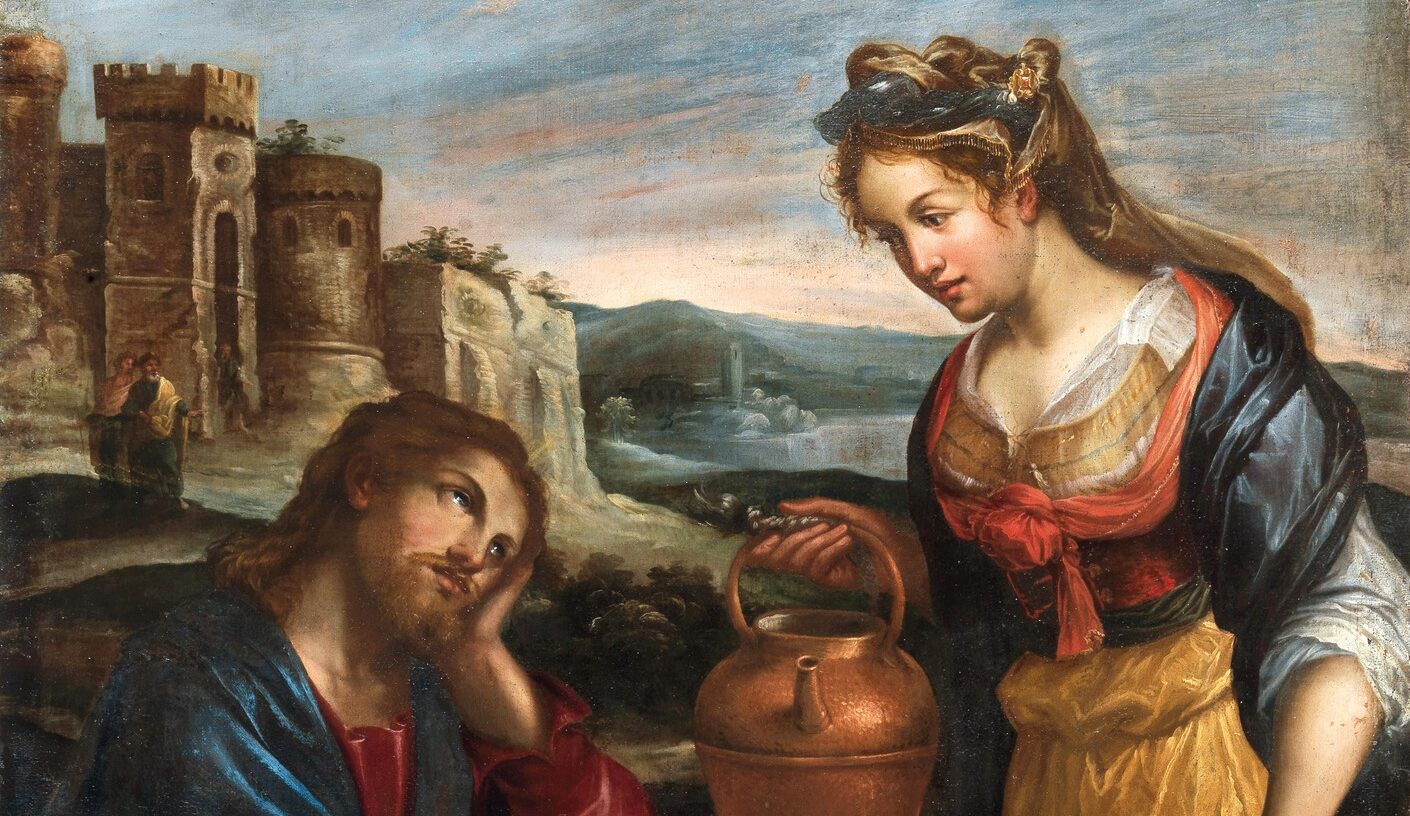
“Those who drink of the water that I will give them will never be thirsty. The water that I will give will become in them a spring of water gushing up to eternal life” (Jn 4:14). This extraordinary claim is a drop in the bucket in the torrent of outrageous events in this passage. Jesus, who has just dismissed the apostles, stops to chat up a woman — a Samaritan to boot, a people in religious and political conflict with the Jews. Christ becomes a provocateur: challenging the woman, revealing the intimate details of her life and charging her to become his emissary to her people, thus breaking every social convention of the age. In this wonderful canvas, painted in 1604, Lavinia Fontana, the first professional female painter in the history of Western art, evidently revelled in the paradoxes of this story.
The gift of water
Jesus doesn’t offer to pay the woman for water, he just says “Give me a drink” (Jn 4:7). He asks something small from her and offers something greater in return. He is generous with his time, answering her questions and engaging her doubts. Christ’s offer of living water, of baptism, can be inferred by his open hand indicating the wellspring of eternal life and by the well head, carved in stone like a baptismal font. Lavina Fontana’s surname means fountain, so we can imagine that the painter took a certain pride in placing the spigot of the pitcher at the center of the work.

Making a splash
Lavinia leaned into the provocative nature of the story, placing Jesus, head resting on his hand, gazing up at the beautiful Samaritan who had “had five husbands” (Jn 4:18) and at present was living, unmarried, with a man. Clearly an attractive woman, she flashes a glimpse of bare leg under her gauzy gown. No wonder the apostles, standing off at the left of the work, necks craned and arms raised, look astounded. But Jesus is absorbed by her soul. Though she towers over him, Jesus’ spiritual beauty draws her to him.

The cleansing tide
The woman returns to her village and announces that Jesus had “told me everything I have ever done!” (Jn 4:29). Her sins were laid bare, yet not only was she welcomed by Christ but dispatched as his envoy of evangelization. A rope tied around the handle of the jug falls to the ground between the two. It is a symbol of penitence, often worn around the neck as a sign of the repentant sinner. Having acknowledged her failings, she is cleansed and transformed into a herald of the Gospel.
Ripple effect
Lavinia Fontana was the first woman to support her family through her painting and the first woman to paint an altarpiece. Assisted by several visionary prelates, she was able to become a “tacit preacher” via her extraordinary canvases placed in prominent churches. The Samaritan woman was sent to preach to her people who “began to believe in him because of the word of the woman.” This startling story of Jesus empowering a woman to convert her people must have resonated deeply with Lavinia as she used her talents to render the Gospel visible and accessible to the people of her age.