


This article first appeared in Our Sunday Visitor magazine. Subscribe to receive the monthly magazine here.
One of the most striking features of the Austrian countryside is the presence of magnificent old monasteries known as Stifte (singular: Stift). The word Stift refers to the feudal domain or endowment given to these monasteries when they were founded in the Middle Ages. The Stifte belong to religious orders that flourished in the feudal period in Europe: the Benedictines, the Canons Regular of St. Augustine, the Cistercians and the Norbertines. While the great feudal abbeys in most other parts of Europe were dissolved either during the Reformation or in the wake of the French Revolution, in Austria many of them survive. To this day, the Stifte play an important role in the religious, cultural, and even the economic and culinary life of Austria.
As religious centers, the Stifte offer traditional monastic hospitality to guests who want to spend some days attending the solemn Liturgy of the Hours and finding solace in the venerable beauty of the old monastic buildings. Monks and canons regular of the various Stifte also serve as parish priests in parishes on the old feudal domains of the monasteries. The form of monastic life in an Austrian Stift tends to be rather comfortable: You will not find the extreme fasting and mortification of the Desert Fathers here. But it is a life nonetheless marked by the old rhythms of prayer, work and study laid down in the monastic rules. It is a gentle and moderate form of religious life, which visitors often find congenial.
As cultural centers, the Stifte are marked by centuries of artistic achievement for the glory of God. Magnificent works of art from the Romanesque and the Gothic to the Renaissance and the Baroque fill them. While they were founded in medieval times, most of the Stifte were rebuilt as magnificent Baroque palaces during the Counter-Reformation as a sign of Catholic Europe’s newfound self-confidence. In solemn liturgies, many of the Stifte still use magnificent brocade vestments from the Baroque period, and some have choirs that sing the full range of sacred music, from Gregorian chant to the orchestral Masses of Mozart and Haydn.

In medieval times, the abbots of the Austrian Stifte ruled over their domains as feudal lords, administering justice, levying taxes and sitting in the Austrian equivalent of the House of Lords. While most feudal privileges have disappeared, the Stifte are still important landowners. Most of them still produce wine on their own vineyards, and some produce beer or liqueur. They nearly all have restaurants in which guests can taste the products of their wine-making and agriculture.

Visiting the Austrian Stifte is a wonderful way to experience the beauties of Catholic Europe.
Stift Melk
The most beautiful stretch of the Danube River is the Wachau Valley, which runs between Krems and Melk in Lower Austria. One can take a boat along this valley and look at the terraced vineyards and apricot orchards along the hills on either side. Often one will see a ruined castle on the crest of a hill or an old parish church among the vineyards. But the most impressive site in the Wachau is the magnificent Benedictine Abbey of Melk, which sits atop a cliff overlooking the Danube, gleaming with yellow and white Baroque façades.
Stift Melk was founded in 1089 by Benedictine monks who were invited there by Leopold II of Babenberg, margrave of Austria. At the time, Austria was still a “march,” a border province of the duchy of Bavaria, ruled by a margrave. Melk had been a castle of the margrave himself, but he donated it to the Benedictines, hoping that they would contribute to both the spiritual and the material cultivation of his realm. Melk became the resting place of St. Coloman, an Irish prince who was lynched nearby after being mistaken for a spy. When the gibbet on which St. Coloman was hanged miraculously turned into a blooming tree, the people realized that he was a saint, and his relics were soon transferred to Melk, which became a place of pilgrimage.
In the early 18th century, Melk was rebuilt as the magnificent Baroque ensemble that one can see today. The abbey church, dedicated to Sts. Peter and Paul, is one of the most glorious Baroque buildings in Austria, full of gold and colored marble and frescoes.
One can visit Melk for a single day to view the breathtaking Baroque architecture and sample the Marillenknödel — Wachau apricot dumplings — and white wine in the abbey restaurant. But one can also spend a few days as a guest to let its beauty sink in even more.
Stift Klosterneuburg
One of the most popular saints in Austria is St. Leopold III of Babenberg. He ruled Austria as margrave from 1095 to 1136 and was notable for his wisdom and prudence, his pursuit of just peace and his founding of many monasteries. His most famous foundation is Stift Klosterneuburg on the Danube, just north of Vienna. Legend has it that on his wedding day to Princess Agnes of Waiblingen, St. Leopold was standing on a hill above the Danube with his new bride when a gust of wind took her bridal veil and blew it away. Years later, on a hunting trip, St. Leopold found the veil, completely unharmed, hanging on an elderbush. A strange light shone from the veil, and then the Blessed Virgin Mary appeared and instructed St. Leopold to build a monastery on the spot. The monastery he built was the Stift Klosterneuburg, a community of Augustinian Canons Regular.

The Emperor Charles VI of Habsburg started building a huge imperial residence attached to the monastery, the magnificent state rooms of which can still be visited. They include a treasury full of rich vestments and the regalia of the archduke of Austria. The Klosterneuburg wines are famous, and on St. Leopold’s feast, Nov. 15, visitors can slide down the side of a giant wine barrel.
Today, Stift Klosterneuburg is one of the most important monasteries in Austria. The community includes a number of American canons, and they recently established a daughter foundation on Long Island in the United States.
Stift Heiligenkreuz
Nineteen years ago, I myself entered an Austrian Stift: Stift Heiligenkreuz, an abbey of Cistercian monks. Heiligenkreuz was founded in 1133 by St. Leopold (who also founded Stift Klosterneuburg). I was drawn to Heiligenkreuz above all by the beauty of the liturgy. To this day, the Liturgy of the Hours and the Mass are chanted in Latin using Gregorian chant. In 2008, our meditative album “Chant: Music for the Soul” made it onto the pop charts in multiple countries. Stift Heiligenkreuz still preserves many elements of its original medieval buildings, including the austere, Romanesque nave of the church, the lofty Gothic sanctuary and the Gothic cloister, which has early Cistercian stained-glass windows.

Guests can stay in our guest wing to attend the liturgy, and let their souls be touched by the beauty of the chant.
The community of Heiligenkreuz is flourishing today, with more than 100 monks and many young vocations. We run a theological institute, where I teach moral theology, and also have the care of more than 20 parishes.
In 2007, Pope Benedict XVI visited Heiligenkreuz. In his address to our community, he noted the importance of Austrian Stifte:
Austria (Osterreich) is, in an old play on words, truly Klösterreich: a realm of monasteries and a land rich in monasteries. Your ancient Stifte, whose origins and traditions date back many centuries, are places where “God is put first.” Dear friends, make this priority given to God very apparent to people! As a spiritual oasis, a monastery reminds today’s world of the most important, and indeed, in the end, the only decisive thing: that there is an ultimate reason why life is worth living: God and his unfathomable love.

A short drive from the monastery is our vineyard at Thallern. Set in the beautiful, rolling hills south of Vienna, it has a traditional monastic grange building with a chapel, including an altarpiece that shows Christ crucified on a vine. There is a wineshop where visitors can taste our wines and our monastic dry gin. It also has a restaurant where one can eat traditional Viennese fried chicken and Austrian desserts.
Stift Schlagl
The Norbertine Stift Schlägl in Upper Austria, near the Czech border, is famous above all for one thing: beer. The monastery was founded in the early 1200s; presumably the Norbertine canons were already brewing beer in the early days, but the formal beginning of the Stift‘s brewery is 1580, when Schlagl beer was first explicitly mentioned in a report of a meeting between the bishop of Passau and the provost of the monastery.

Today Schlagl brews mostly Czech-style beers that are well regarded throughout Austria. Visitors can tour the brewery and take a highly enjoyable beer-tasting class. The brewery is now operated primarily by lay employees, since the Norbertines of Schlagl are mostly engaged in pastoral work in the parishes around the monastery.
Stift Admont
High in the mountains in the center of Austria lies the Benedictine Abbey of Stift Admont. Stift Admont was founded in 1074 by the archbishop of Salzburg using lands that had been donated by St. Hemma of Gurk (a noblewoman who is one of the patron saints of childbirth). Admont is famous above all for its magnificent Baroque library, the largest monastic library in the world. Entering the library of Admont is like entering a fairy-tale world. The curved walls are lined with ornate bookshelves, holding beautifully bound volumes. Above the shelves a gallery winds its way around, giving access to a second level of shelves. Colored marble columns support the domed ceilings, covered in Baroque frescos. It is a breathtaking spectacle.
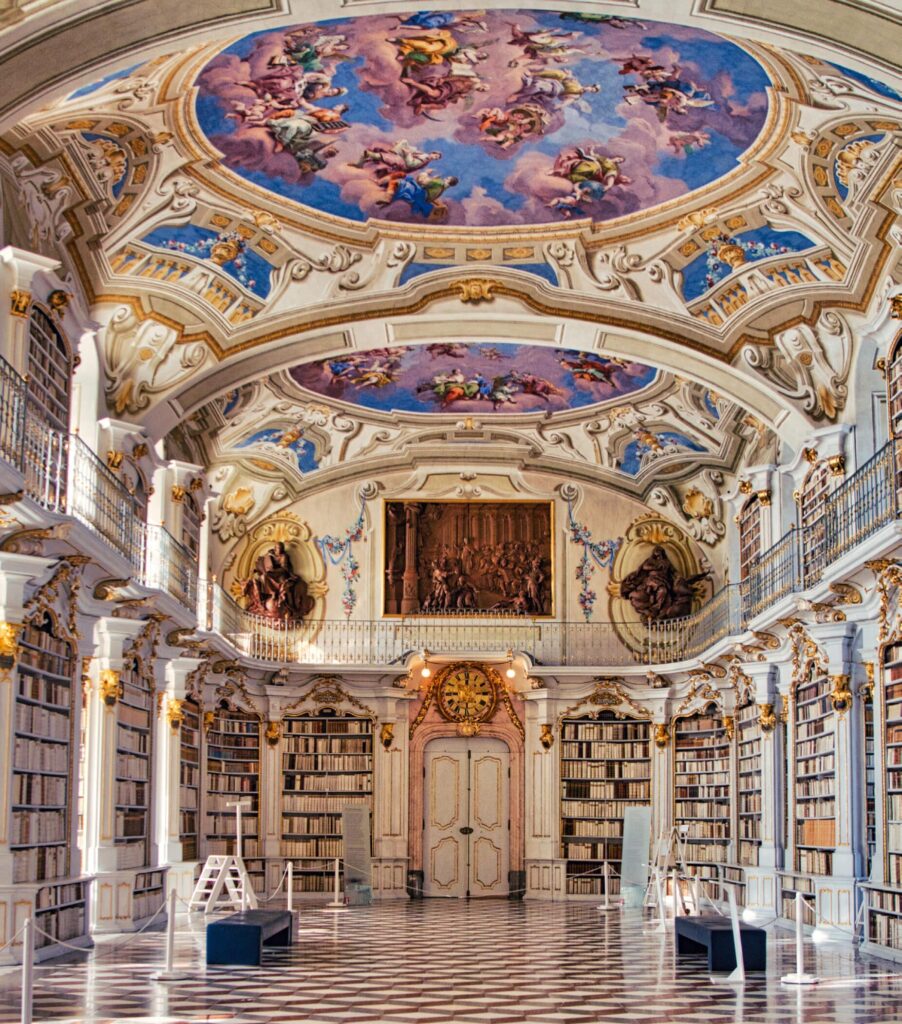
The abbey church of Admont was burnt in a fire in 1865, but was rebuilt as a lofty, neo-Gothic minster. Today, the community of Admont includes 26 monks, many of whom work as parish priests in nearby parishes, or as teachers in the abbey’s high school. Admont has many guest rooms where visitors can stay for days of recollection, or to go hiking in the nearby mountains.
Stift St. Peter
The oldest Stift in Austria is the Benedictine Archabbey of St. Peter in Salzburg. Founded by St. Rupert, the first bishop of Salzburg, in 696, it has now been in continuous existence for 1,329 years.
Unusually for an Austrian Stift, St. Peter is not in the countryside, but in the center of the city of Salzburg. Visitors to Salzburg can easily drop in to attend chanted Sunday vespers at 6 p.m. in the magnificent abbey church, with its Baroque decorations, or to visit the Gothic St. Mary’s Chapel, or to take a walk in the beautiful graveyard behind the abbey, full of historic funeral monuments.

St. Peter is also famous for running the oldest restaurant in the world: St. Peter Stiftskulinarium, first mentioned in the year 803 in a poem by St. Alcuin of York. Today, this restaurant serves traditional Austrian cuisine and Austrian beer.


