
Growing up, Matthew Das loved learning about theology. His parents, both devout Presbyterians, frequently talked about their beliefs at home.
When Das arrived at Regent University in Virginia Beach, Virginia, for college, he was excited to converse with and debate his fellow Protestants about Christian theology at the evangelical school.
He was not expecting, however, to fall in love with Catholic theology and eventually enter the Church.
“My dad was an elder at our church and so I always loved talking to the elders and my pastors about Christianity and its history,” Das said. “I became very involved in apologetics; that was my thing. I love apologetics. I love formal reasoning. I loved all of it, but I was very Protestant.”
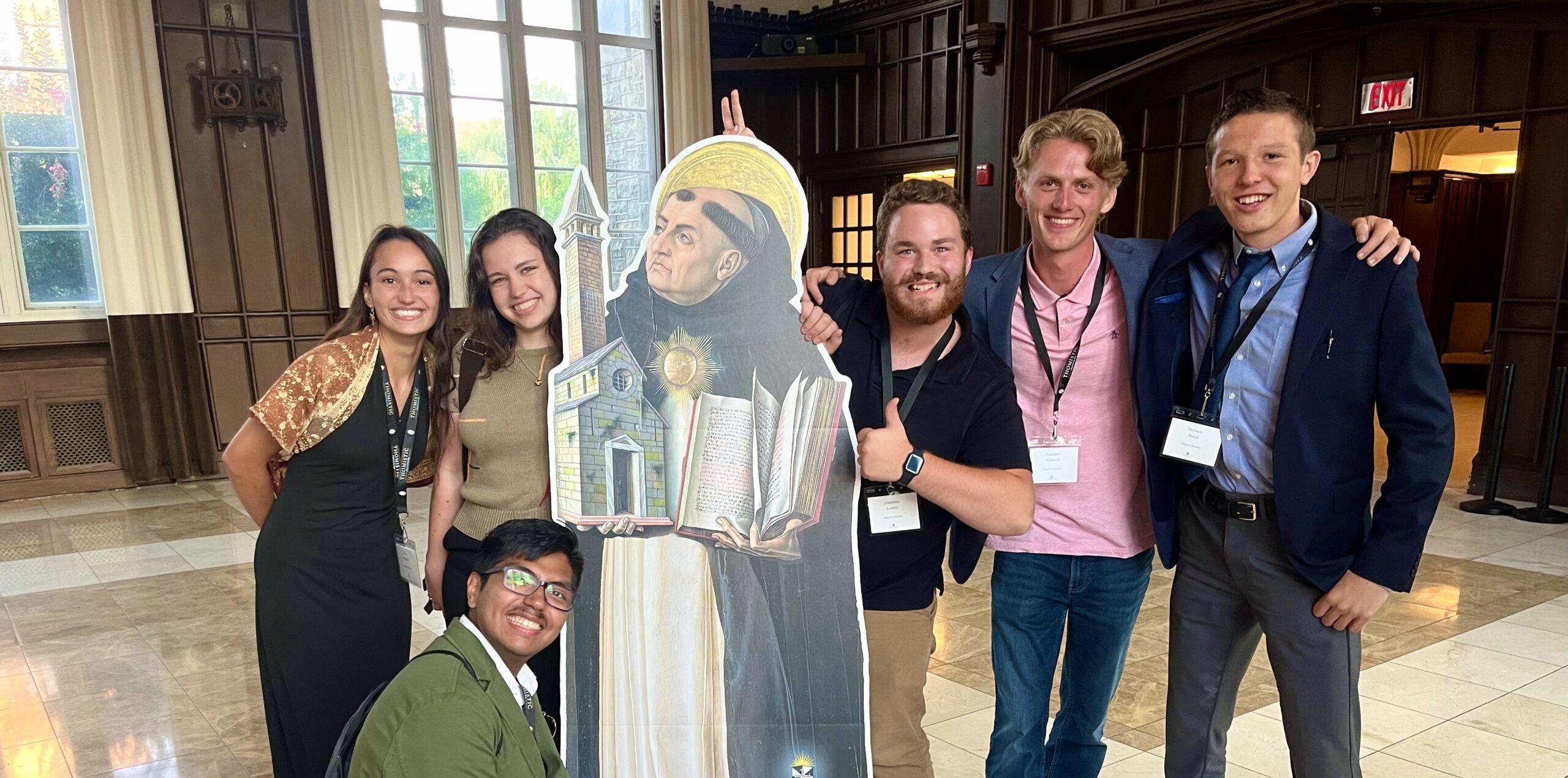
Then he met Seth Bauer, former president of the university’s chapter of the Thomistic Institute, who invited him to come to an event that the group hosted. The two quickly became good friends.

“We both had a similar passion to try to bring other Christians to understanding more about their faith, taking it a bit more seriously,” Das said. “Our friendship grew out of going to Thomistic Institute events and just enjoying the speakers and conversations.”
To know in order to love
The Thomistic Institute is an international organization, launched nine years ago by the Dominican House of Studies in Washington, D.C., that seeks to help students encounter the intellectual tradition of the Catholic faith through events on college campuses in the United States, Ireland and England.
“You cannot love something or someone that you do not know,” explained Father John Mark Solatario, the institute’s coordinator for campus outreach. “Hopefully, by giving students an opportunity to contemplate the truths that are given us by the Church, by revelation, by the Church fathers, they can learn from those sources, and they come to know Christ so that they can enter into a deeper relationship with him.”
Through attending these Thomistic Institute events, Das saw the truth and beauty of the Catholic intellectual tradition and began to read more about the Church.
“I disliked Catholicism because I was always so confused as to why they had so much knowledge — but, obviously, they must be wrong,” Das said. “Eventually, as I learned more and more about Catholicism through Thomistic Institute events and conversations, I went on some retreats, and I began to realize that this all makes sense.”
“The first step towards Catholicism is just admitting to yourself that it makes sense,” Das continued.
“I was becoming more Catholic in habit, and then in a true Thomistic way, my habits started influencing my heart,” Das said. “I said one day, ‘It’s really hard for me to stay Presbyterian,’ and I was just kind of lost,” Das said. “The more I tried to understand God and Christianity as a whole, the more I thought that God was drawing me to become Catholic.”
Eventually, he became convicted, and he entered the Church this past April.
Sparking conversation
Unlike other college missionary groups like Saint Paul’s Outreach or FOCUS, the Thomistic Institute seeks to encounter students through their academic pursuits.
“The Thomistic Institute is geared to be a pipeline that goes right into the heart of the academic life of campus,” Father Solatario said. “The Thomistic Institute wants to be a conversation partner with people who are pursuing sciences or liberal arts, philosophy, engineering, medicine, to know that those are all ways that one can approach the truth that ultimately reflects the wisdom of God.”
At Regent University, Das has seen a shift in the college’s culture that he attributes to the institute.
“There are so many people interested in liturgical beliefs (and) Christian history because they were inspired by the talks,” Das said.”It is not that many people are converting at Regent — it’s more that they’re able to apply what they’re learning and actually use it regardless if they are Catholic or not.”
Through the Thomistic Institute, Das fell in love with Catholic theology and thereby with the Catholic Church. Now, as chairman of Regent’s chapter of the Thomistic Institute, he hopes to help others fall in love with the Church too.
“God is drawing them to him through us. It’s a real responsibility of ours, but it is also such a great privilege,” Das said. “We always told each other that the Thomistic Institute was never a club, it was never just some student organization. It was a ministry that we all had the ability to take part in.”