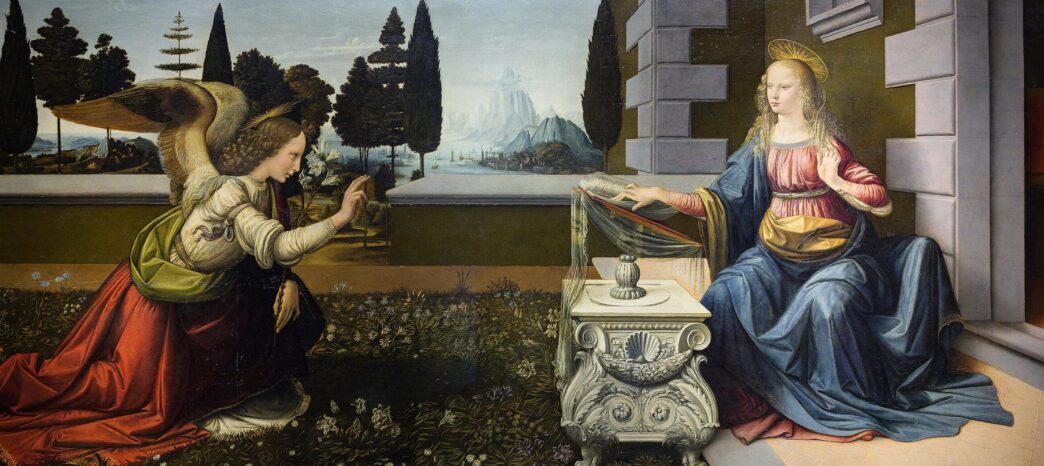
Despite being baptised in the Church of Ireland, the Irish writer Oscar Wilde was fascinated by all things Catholic. As a dramatist (in both his professional and personal life), Wilde may have been attracted in part by the high aesthetics of the Catholic Church. But when, on a visit to Florence in 1881, he stumbled on the Mother of God at her Annunciation, his expectations were upended.
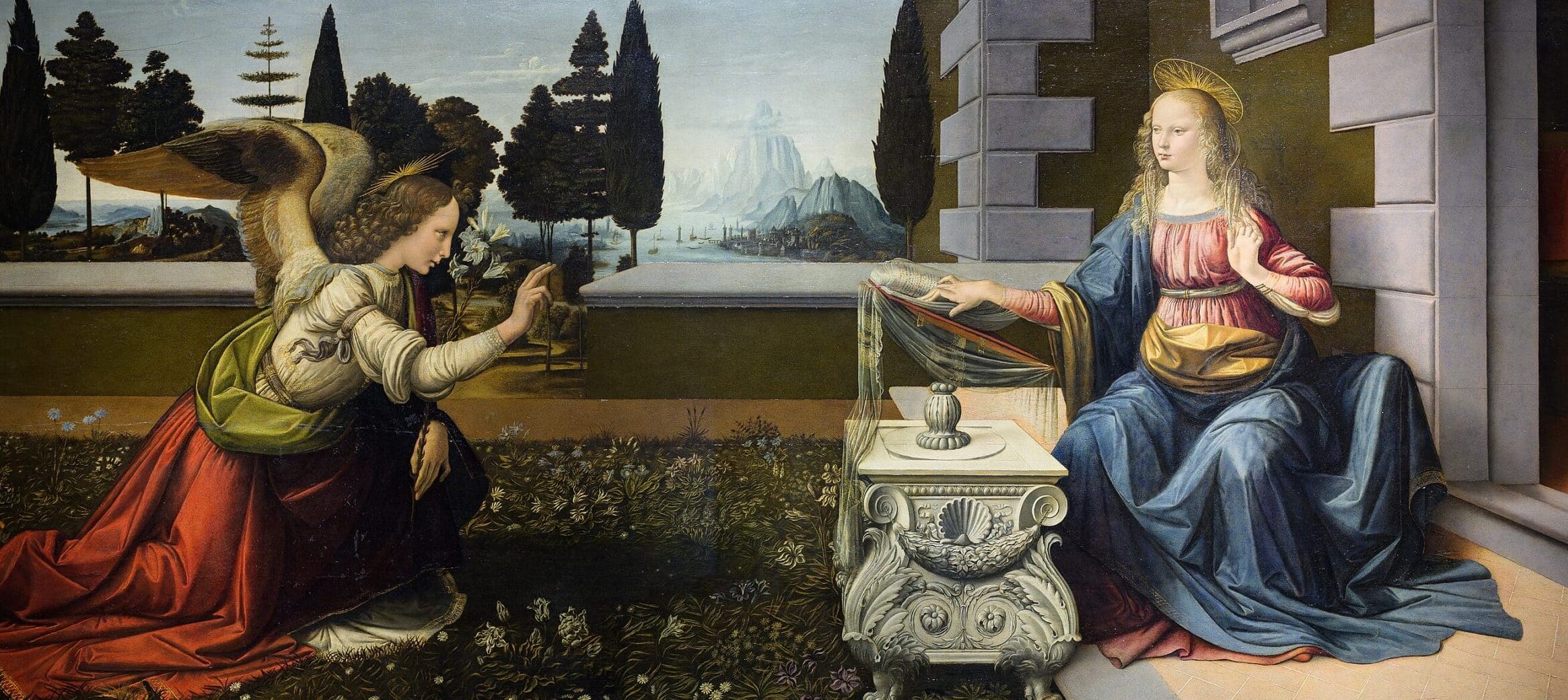
You may know the Leonardo da Vinci painting of the Annunciation that Wilde saw in the Uffizi Gallery, and that he would later describe in his poem “Ave Maria, Gratia Plena.” Angel and Virgin are in classic Annunciation pose. Mary is seated at a lectern; the angel, with his mighty wings, kneels before her in obeisance. The angel is strikingly earthly (he even has a shadow). Mary seems to be, unexpectedly, the essence of calm.

The painting, Wilde’s poem suggests, is almost underwhelming. Of course, Wilde knew the scriptural story. He would have read Luke’s startling yet quiet account of the conversation between the angel and the girl that would change the world forever. Yet, as a dramatist, Wilde also knew how God could have had it play out.
In these lines he recalls the mythical, flamboyant impregnations of Danae and Semele by Zeus — how the Greek god arrived in a shower of golden stars for Danae and descended in the guise of an eagle to Semele as she bathed in a river. These scenes, he suggests, are worthy of the earth-shattering conjunction of god with woman; this is the imagery we might expect. Yet, when with such glad dreams (he) sought this holy place, the poet comes before a sign of the one God in the halls of an Italian art gallery and falls, at least metaphorically, before this supreme mystery of Love.
Throughout his life, Oscar Wilde ran toward the Church, then away from it. On one occasion he failed to turn up to his own reception into the Church, sending a box of altar lilies to the priest in his stead. On his journey of prevarication, Wilde would have discovered, as we all do, that God is unexpected. He doesn’t threaten, yell or stun us with pyrotechnics. What Wilde ran from, and to, was the still small voice that Elijah heard (1 Kgs 19:12), the God who did not knock Mary off her feet when he sent her his angel. God, the unexpected realist of the New Testament, who came into our world as flesh-and-blood man and encourages us to look for him in the most unexpected places — in healings and resolutions, yes, but also in confusion, disputes and ordinary, quiet afternoons.
Wilde’s poem seems to tell us that God will catch up with us in the stillness of anywhere when we, even inadvertently, leave the door open to him. Fourteen years after his visit to Florence, God would come to Oscar Wilde in a prison cell. And then on his deathbed, when Wilde, against all expectation, was finally received into the Church and allowed this mighty stillness to take him home.
Ave Maria, Gratia Plena
By: Oscar Wilde
Was this His coming! I had hoped to see
A scene of wondrous glory, as was told
Of some great God who in a rain of gold
Broke open bars and fell on Danae:
Or a dread vision as when Semele
Sickening for love and unappeased desire
Prayed to see God’s clear body, and the fire
Caught her white limbs and slew her utterly:
With such glad dreams I sought this holy place,
And now with wondering eyes and heart I stand
Before this supreme mystery of Love:
A kneeling girl with passionless pale face,
An angel with a lily in his hand,
And over both with outstretched wings the Dove.