


I spent my childhood passing within five miles of an approved Marian Apparition, and I had no idea. In 1859, the Mother of God appeared to a young Belgian pioneer named Adele Brise in what is now known as Champion, Wisconsin.
Driving through a countryside of fields, barns and prairie, it’s hard to imagine that just 150 years ago, all this land was virgin forest, dotted here and there with clearings made by immigrants newly arrived from Belgium. Lured by the promise of cheap land “suitable for farming” and a “mild climate,” they sweated and bled to clear dense forest and froze — some to death — during their first winters.
“They were very much carving out a home from nothing,” explained Sandy Orsted, treasurer of the Belgian Heritage Center in Brussels, Wisconsin.
On October 9th, 1859, Adele walked with some friends on a 10-mile journey to Mass when she saw what appeared to be a woman standing between two trees with a luminous glow about her. On the way home from Mass, in the same place, the woman appeared again. Adele fell to her knees and asked, “in the name of God, who are you and what do you want?”
The woman replied, “I am the Queen of Heaven who prays for the conversion of sinners, and I wish you to do the same.”
“What are you doing here in idleness,” Mary continued, “while your companions are working in the vineyard of my Son?”
“What more can I do, dear Lady?” Adele implored.
What was in Adele’s heart at that moment, I cannot guess. But many years earlier, Adele made a promise. On the day of her first communion, Adele and several of her friends promised Our Lady to join the order of religious sisters that had prepared them to receive their sacraments. Adele was deeply impressed by the sisters’ instruction and longed to do as they did: Spread the Gospel by teaching children the Faith.
However, her parents’ decision to immigrate to the United States forced a difficult decision on Adele: Move with her family or join the sisters as she had planned. On the advice of her parish priest, she sailed to America, leaving her promise and her plans behind.
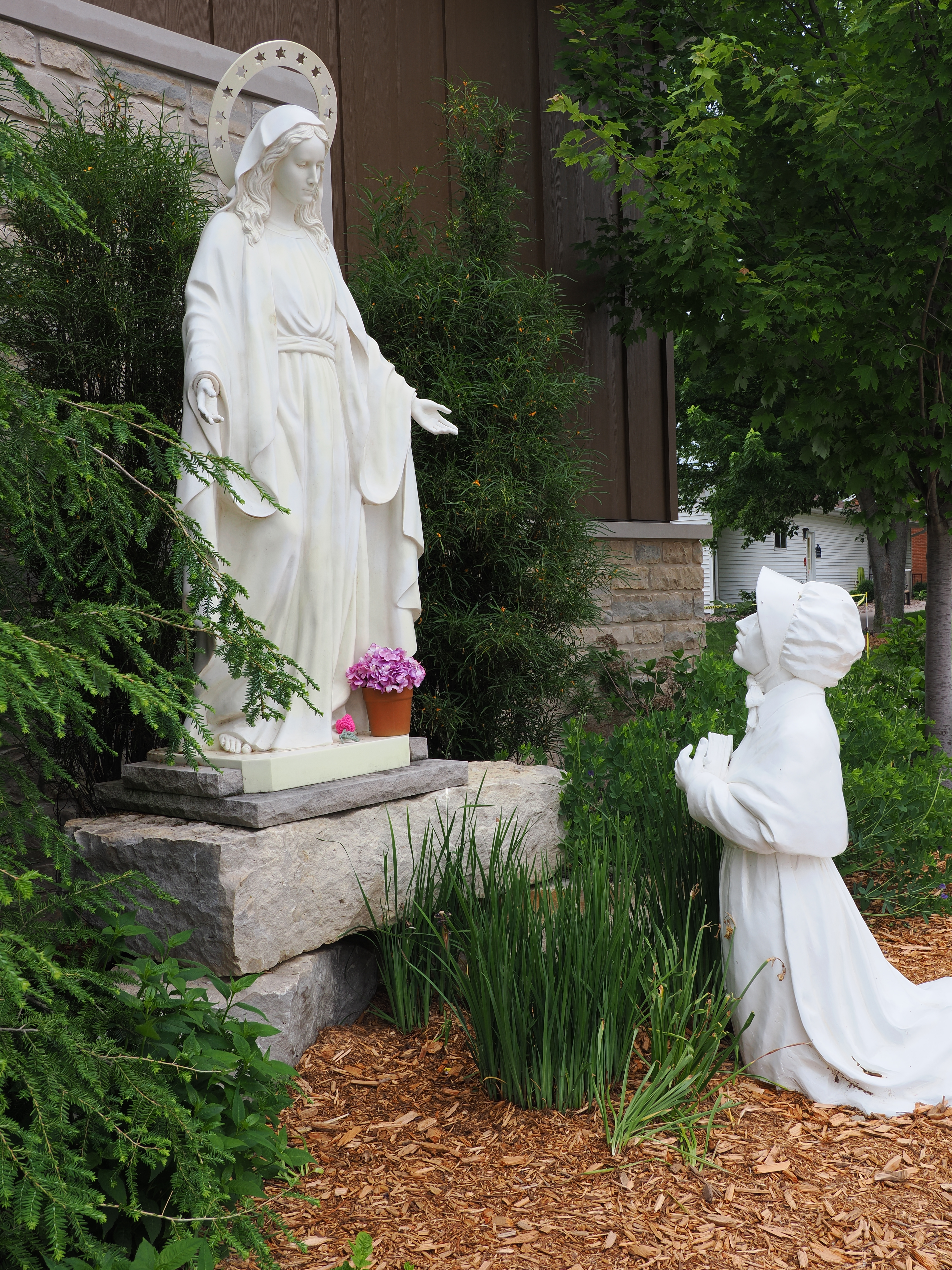
But Our Lady met her in America and gave her a way to keep her promise: “Gather the children of this wild country,” Mary instructed, “and teach them what they should know for salvation.”
“How can I teach them who know so little myself?” Adele said.
“Teach them,” continued Mary, brushing her objection aside, “their catechism, how to sign themselves with the sign of the cross, and how to approach the sacraments; that is what I wish you to do. Go and fear nothing, I will help you.” Then she disappeared.

Adele never learned to read or write very well. She had no degrees or credentials to teach anything. But she knew that she needed Jesus very much and longed to spread the Gospel. That was enough.
Door-to-door catechist
When our Lord asked St. Francis in a vision to rebuild his Church that was falling into ruin, Francis’ response was immediate: He began to fix up the dilapidated San Damiano chapel in which he had been praying at the time.
Adele also had an immediate response to Mary’s instructions: She started walking. Adele walked from home to home, knocking on the doors of her neighbors and asking to teach their children the Faith. Some families welcomed her, others refused.
“These were somewhat primitive times,” Orsted told me. “The people who came to Wisconsin were often not educated. They often could not read or write … Everyone had hard work to do.” With so much time given to survival, little time was left in the home for instruction, and the infrastructure to support faith formation — like a local parish or a school — was nonexistent.
So Adele offered to do the children’s chores in exchange for the privilege of teaching them. Her instruction was primarily oral: telling stories, singing songs, making the sign of the cross.
Meanwhile, her father, Lambert Brise, built a small, wooden chapel marking the spot where Mary appeared — the site’s very first chapel of “Notre Dame De Bon Secours” or Our Lady of Good Help. Chapels of this kind were common in Belgium and used by passersby as places to pause and pray as they went about their day. The Belgian immigrants brought the practice to their new home in Wisconsin.
“They built these roadside chapels. Often in thanksgiving and gratitude for graces received. The Shrine began as a little roadside chapel to commemorate Mary’s appearance to Adele,” Orsted told me.

Many of these chapels still stand. And local families still build them. A few years back, my husband and I chose five of the chapels to visit and prayed a decade of the Rosary in each one. One my favorites, the Little Chapel of the Sacred Heart, sits near an old cemetery with burials dating back to the 1860s and 70s. These people could have known Adele; maybe some were her students.
Adele walked, worked and taught in a 50-mile radius for about five years. Eventually, more women joined her mission. In 1864, the local community built a farmhouse and a school to accommodate Adele and her companions, now Third Order Franciscans, and families brought their children to her.
In 1869, the school, now called “St. Mary’s Boarding Academy,” began to take in children, some with special needs that their families couldn’t meet. She gave them a home, relying on God’s providence and the community’s generosity. Adele developed a practice of praying novenas for the various needs of her school.
“Adele would have been known in her community,” said Orsted. And the community rallied around her mission. Sometimes, a team of men would come and raise a building for her, sometimes families dropped off food and supplies for the school, Orsted explained.
Grassroots devotion
As Adele’s ministry grew, so did the chapel that marked Our Lady’s appearance. Her father’s tiny chapel was replaced by a larger one. More people came to pray and more prayers were answered, sometimes in miraculous ways. The chapel grew larger still. The community’s devotion continued in this way for decades. “The chapel,” as the locals still call it today, is the place to go when you really need something.
“People would go to their local parish, but when things were really bad … you went to the chapel,” Orsted explained.
Barb Chisholm, a historian at the Belgian Heritage Center, recalls her mother gathering up her neighbors when tragedy or disaster struck to meet at the chapel to pray.
“You’d get nine women to go to the chapel and pray the Rosary,” Chisholm said, “a novena!”
Chisholm herself recalls meeting at the chapel with her friends during nursing school, praying to pass the board exams.
Theresa Alexander, whose ancestors were among the earliest immigrants from Belgium, has been praying at the chapel for more than 80 years.
“I remember my mother telling my father to wear his old pants when we went to the chapel,” Alexander told me. Because they would process around the sanctuary praying the Rosary … on their knees.
For 150 years, this deeply devoted, now multi-generational immigrant community supported the chapel spiritually and materially. Then, on December 8th, 2010, the United States gained its first approved Marian apparition when Bishop David L. Ricken of the diocese of Green Bay declared the 1859 apparitions “worthy of belief,” confirming what Orsted, Chisholm and their community already knew.
“We always knew that it was a special place,” said Alexander.
A steady stream of souls
Once each year, my family of seven journeys 1,000 miles to visit my parents on the Door Peninsula of Wisconsin. On the way, we love to stop at the National Shrine of Our Lady of Champion — the name was changed shortly after it gained ecclesial approval. Just a few small road signs point the way to the simple grounds surrounded by farms, fields and forest — and those few signs still point to “Our Lady of Good Help.” A few miles west are the sparkling waters of Green Bay. Door County, which begins a few miles north of the shrine, has some of the most breathtaking land in America.
It’s easy to bring a family to the shrine, now ministered to by The Fathers of Mercy, led by Father Anthony Stephens, CPM, who serves as the shrine’s rector. Our family’s typical visit to Champion usually begins with 11 a.m. Mass, followed by an outdoor picnic on the grounds.
A steady stream of souls comes to Champion each year. You’ll still find locals continuing their family’s devotion, but now others come from much farther afield to seek Our Lady’s intercession.
“They just love Our Lady and want to come where she appeared,” Father Stephens told me.
What visitors find at the shrine is a clear sense of Mary’s presence and the kind of peace that the world cannot give.
The shrine continues Adele’s novena devotion by praying several public novenas throughout the year, leading up to various major feasts like the Solemnity of the Sacred Heart and the Assumption of the Blessed Virgin Mary.
My favorite place at the shrine lies just below the main altar in the apparition oratory. The room is small, warm and illuminated by hundreds of candles lit by pilgrims who come to Champion carrying their intentions. It smells strongly of candle wax and flame. In the center stands a statue of Our Lady after the manner of every other life-sized Mary that holds the right flank of a Catholic altar.
I’ve brought significant intentions to our Lady’s feet over the years. They are almost never answered the way I expect. But in that oratory her words ring in my heart afresh: “Go and fear nothing, I will help you.”
There could be no simpler or greater comfort than those words.
Father Stephens chuckles knowingly as I share this experience.
“Jesus is happy when we honor his mother,” he said. “And he’s generous.”
But, pilgrims experience God’s generosity most profoundly in the Shrine’s rich sacramental life.
Holy Mass is celebrated every day. There are several hours of adoration of the Blessed Sacrament and hours upon hours of confessions. All of it is celebrated beautifully and reverently.
On Christmas Eve night of 2019, my husband and I drove through a snowstorm to attend the Midnight Mass at the Shrine. Mass was quiet, unassuming, but charged with love.
“We are right down the line Catholic,” Father Stephens explained. “It’s Mary’s agenda here; we are just letting Our Lady do her thing. Mary brings (pilgrims) to Mass and sometimes she shoos them into the confessional.”

And here lies the greatest miracle of the Shrine: The sacraments. At least once a week, Stephens says, someone walks into the confessional with no previous intention of doing so, and becomes reconciled to Christ and his Church.
So many of us in the United States descend from the immigrants of the 19th century. It is fitting that Our Lady chose to appear in our country to an immigrant. Like the mining communities of Appalachia or the fishing communities of New England, immigrants in the U.S. banded together to support each other, relying on God to provide for their needs. How wonderful that we, their descendants, can draw near to Our Lady where she first drew near to us in the U.S.
“Come to Champion,” Stephens said, “and see what our Lady might be able to say to you.”


