The room feels stuffy, the music is a bit too loud, and the atmosphere is anxiety-provoking. Dressed in your most uncomfortable formal attire, you are at your company’s regional corporate holiday party. You didn’t particularly want to attend, but networking is essential, your boss reminded you. The RSVP specified that children aren’t welcome, so your spouse is home with the kids. Standing alone, holding a glass of mystery wine in one hand and a rubbery stuffed mushroom in the other, you look around anxiously, trying to see someone who looks important, and to whom, therefore, you should introduce yourself.
Clearly others are thinking the same — someone from another branch you haven’t met comes up to you. In between the awkward small talk, you reveal your lowly position in the firm. Promptly your conversationalist needs a drink refill and disappears. You know he will not be coming back. Others in the room are similarly anxious, and their discomfort manifests in different ways. Several people are glued to their phones. One has been stationed at the bar the entire time, drinking excessively. In one corner of the room, an argument seems to be brewing. Based on snippets of the conversation, whose volume has been rising, you know it’s a political argument. You’re staying clear.
At last, you glance at your own cell phone, realize that you’ve been here for more than an hour, and decide that you’ve made enough of an appearance to be able to politely disappear. You breathe a sigh of relief as you start your car and drive home. But straightaway sadness sets in. Parties are supposed to be fun, or so we’ve been conditioned to believe from a young age. So why aren’t they?
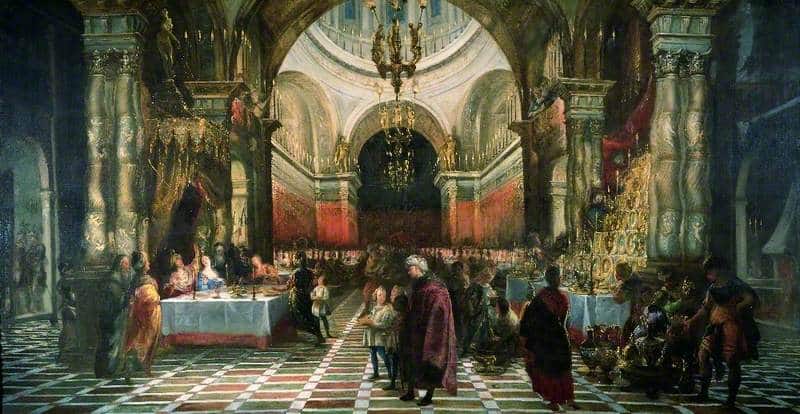
Imagine another party, this one around A.D. 1399. In a large hall, tables are arranged in a U-shape with simple benches for seating. Guests fill all available spots, and food on platters is set out at regular intervals on the tables so everyone can reach it. The fare is simple: boiled meat, coarse bread, hard-boiled eggs, some cheese, the season’s fruit. Before the trendy modern exhortations to “eat local,” eating local is simply the practical reality of life. Only whatever was in season is available — including for parties. Furthermore, without sugar, dessert as we know it today doesn’t exist. But, hard as it is to believe, even without cookies as we know them, joy abounds.
The tables, strewn with plates and crumbs, are increasingly messy as the night proceeds, and so are the diners’ hands — everyone, after all, is eating the bread and the meat with their hands, although knives at times could be used to assist. Hunting dogs, who helped out with the provision of meat for this party, are roaming the hall, happily gathering anything that falls from the tables. At least that helps with cleanup. Conversation is loud and hearty. Children are present as well, adding to the mess and the joyful noise. No one is isolated — the chaos incorporates all who are present, and they all engage with others naturally, simply, casually. Among the guests is a traveling minstrel. Grateful to be paid with a good meal, he waits until a moment when the eating slows somewhat, then gets up and strikes a tune. Some of the women and girls get up and begin dancing in a circle.
The contrast between this scene and the gruesome corporate holiday party you just endured could not be clearer. Somehow, with all our modern American abundance, we have lost the art and simple joy of parties. Could the solution be as simple as going medieval?

Inspired by holy days
In the Arthurian courtly romances of the 12th-century French poet Chrétien de Troyes, every tale of a spectacular knightly quest opens with a liturgical holiday, celebrated joyfully in community. In attendance on each occasion is the entire court — especially the knights of the Round Table. Normally scattered on their various quests, at these celebrations they are all together. Everyone eats too much, delays at the table, and is reluctant to part from each other’s company once the party is over. The descriptions of these parties are fairly brief. Yet their placement at the beginning of each tale is significant: They directly launch the events that follow.
For instance, the tale “Erec and Enide” begins with the court’s celebration of Easter: “On Easter day, in springtime, at Cardigan his castle, King Arthur held court. So rich a one was never seen, for there were many good knights, brave and combative and fierce, and rich ladies and maidens, noble and beautiful daughters of kings; but before the court disbanded the king told his knights that he wanted to hunt the white stag in order to revive the tradition.” In a complicated set of events during the stag hunt, the knight Erec meets Enide, whom he then marries on Pentecost.
Similarly, the tale of “Lancelot, the Knight of the Cart” opens with another spring holiday, Ascension Day. Soon after, however, Queen Guinevere is abducted and Lancelot goes on a quest to rescue her. “Yvain, the Knight of the Lion” opens with a court party for Pentecost, before Yvain goes on a series of quests, including the rescue of a friendly lion.
In each case, the liturgical holiday offers a pretext for a spectacular party. And each time Chrétien emphasizes the nobility of the company and the beauty of the celebration. There is no question about it: These parties are good. They are orderly and civilized, reflecting the noble character of those present. But then the party ends, and ordinary time resumes with a knightly quest. This sequence of events is no coincidence. The timing strongly suggests that it is these parties that strengthen and inspire the knights, encouraged by their time celebrating together, to go on and perform heroic exploits.
Chrétien’s romances were written for the court and read for the court — including at parties. In the process, he encouraged his audiences to remember that parties are good — and they can make the celebrators better. For noble knights and ladies, participating in such parties could set the stage for great feats. But holidays were not the only occasions for parties in the Middle Ages. Some parties came in response to disaster.
Creative but orderly
In 1347, ships arriving from Crimea to the bustling Italian city of Genoa brought something much less exciting and significantly more lethal than spices and silk. It was a mysterious illness that spread throughout the Italian peninsula, reaching the city of Florence by the spring of 1348. Its extreme contagion and high death rate threw everyone into a panic, utterly disturbing morals and values, turning previously civilized citizens into savages who refused to even bury the dead. Some, assuming they would die soon anyway, decided to spend their last days on earth in debauchery — definitely not the good kind of parties.
The Italian writer Giovanni Boccaccio was not in Florence himself during the Black Death, but he learned about the plague and began writing his book “The Decameron” while the plague was still raging. His introduction to the work vividly describes the dissolution of civilized society in the city. The chaotic parties of those who decided to drink away their final days are reminiscent of the ethos of Trimalchio, a character of Roman satire who too knew no restraint in his dinner parties. But what if another kind of party is possible in the age of the plague, representing a more virtuous way of dealing with a stressful situation? That is the framing plot for Boccaccio’s book.
A group of seven young women and three young men opt for a different approach than the rest of Florence: They flee the city for a two-week house party in the countryside. There they isolate themselves and devote themselves to telling stories for entertainment. “The Decameron” is named for their 10 days of storytelling, during which the creative partyers each tell one story a day, for a total of 100 stories.
This unusual party during a crisis recognizes something important about the comfort of friendships and parties in the worst times in life. Consider the pandemic lockdown of March and April 2020. Some people were utterly alone for weeks or months — no, Zoom parties were not the real thing. For a time, gatherings of more than 10 people not related to each other were forbidden by law. In Boccaccio’s narrative, the 10 lockdown companions are not related to each other by either blood or marriage; they just happen to find themselves together in difficult circumstances and decide to try an unusual solution as a group.
But more than simply time spent together, their party was a party of books, about books, driven by books. For that is where the stories they tell come from, some more recognizable than others, drawing especially on classical authors — for example, Ovid — but more recent literature and history as well. This means that there was an implicit qualification to be admitted to the party: One had to be a book lover. The 10 also came up with rules for their party, acknowledging the need for order to keep such gatherings civilized. A different member of the 10 was in charge each day, and the designated daily host set the rules for the types of stories to be told that day.
Of course, this party never happened. It is a literary hack that allows Boccaccio to collect 100 quirky stories into a single book. And yet, it reflects real interests from the Middle Ages and offers application for us today. Storytelling and parties have gone hand-in-hand since antiquity, when public entertainment involved dayslong recitation of the Homeric epics. In the Middle Ages, troubadours and other performers were popular in European courts, providing music and storytelling for entertainment at gatherings large and small.
Every day a reason to celebrate
We forget sometimes that any day of the year is suitable for celebration if we make the time for it. Every day of the annual calendar in the Middle Ages had particular saints’ feast days associated with it — some local and some known universally. As a result, there was potential for every day of the year to become a party in honor of a particular saint. In many medieval villages, for instance, Nov. 22, the feast day of St. Cecilia, the patroness of music, was an occasion for musical celebrations.
Just a few days later, the feast day of St. Catherine of Alexandria on Nov. 25 would have offered another party opportunity. Like St. Cecilia, Catherine was martyred by the Romans for her faith. Because she didn’t live long enough to get married, her feast day became a special occasion for unmarried girls to celebrate together and pray for husbands. It also involved a particular food — Cattern cakes.
Not all of these daily saints’ feasts were occasions for significant parties, but some were. And not all of them were celebrated by everyone. St. Catherine’s feast, for instance, was more relevant to some than others, depending on life circumstances. Still, parties in honor of saints were commonplace. The popularity of these celebrations reminded medieval Christians that the ultimate party is the one yet to come.
The prison journal of one martyr, St. Perpetua, which she wrote shortly before her martyrdom in 203, describes a vision which presaged her martyrdom. In this vision, she ascended a ladder to a heavenly garden. There a joyful crowd welcomed her to their party, while a shepherd host dressed in shining white lovingly fed her a sweet cheese curd. We may party here on earth, but the best party ever is in the future.
Party lessons for today
These stories of parties, literary and otherwise, are all centuries removed from us. Still, the human experience has not changed so much. Life on earth is not easy, even as our challenges are different. I contend that we can take from the medievals a number of concrete lessons to motivate us to party joyfully and virtuously as Christians today. I propose the following list of 12 — a good biblical number.
1. At the most obvious level, we need parties — in good times and in bad, because Christians should encourage each other in joy and in sorrow!
2. Parties for liturgical holidays are an obvious place to start. Consider inviting people from church who might not have anywhere else to go.
3. Parties should be long. This is not always possible, but we see how in the Middle Ages, people often blocked off an entire day — or even longer — for celebrations.
In my own family, we structure our homeschooling year specifically so that we can take the entire month of December off from everything but preparing for Christmas. We read seasonally appropriate books and devotionals, we enjoy the tree, we bake too much and we savor the season — including its parties. One year, we organized a Christmas party that doubled as Cicero’s Death Day party: The fabled Roman orator was assassinated Dec. 7, right at the beginning of Christmas party season. We decorated the house with famous Cicero quotations and served Christmas desserts. The combination proved highly enjoyable.
4. Music and a good party go hand-in-hand. Go medieval in your party entertainment — fill your ears and mind with the good, the true and the beautiful!
5. Poetry at parties is great too.
I know we sound like cliché homeschoolers, but my kids love poetry tea, usually held mid-morning or mid-afternoon, when everyone needs a little pick-me-up to make it to the next meal. Poetry tea is exactly what it sounds like: I make a pot of tea, set out a platter of snacks and we read poetry. A few times this past summer, my kids had friends over who joined us for poetry tea mid-morning. On another occasion, these same friends were over at lunchtime. When I served sandwiches for lunch, a clamor arose: But where is the tea? And where is the poetry? They promptly found a book and started reading aloud while I made tea to go with their lunch.
6. On a related note, book or storytelling parties are first rate! The reading aloud of books at meals was common entertainment in the Middle Ages. As evidence mounts for the destructive power of screens in our lives and in our entertainment, going medieval is the ultimate good party hack.
7. Medieval food wasn’t fancy by our standards. They didn’t even have sugar! Yet eating simple fare with company made it special. This is good pushback to our stressful foodie culture: You really don’t have to serve extravagant meals at a party! A fruit platter, bread, some meat and cheese were good enough for King Arthur’s parties, and they’re good enough for us.
8. A good party requires some basic ground rules. The host can subtly maintain order.
9. Even at a well-organized party, crazy stuff is bound to happen, but that just makes the party more memorable, more clearly delineated from ordinary time. Perhaps no supernatural creatures will show up at your party. But kids might do something unexpected.
10. Some parties are for everyone, but others are for a particular group. Both are good. Women can party with other women; men with other men; kids’ birthday parties are a joy. But parties for all your friends are a blessing too.
11. Have the right attitude about parties: no parties here on earth will be perfect — but the one in heaven will be!
12. Ordinary time seems sweeter after a good party. Consider as the party ends: Into what quest might it be launching you?
This last point is important. Parties offer us a break from the ordinary; they welcome us into a time of joy that can be truly extraordinary. But what happens once the party is over? In the liturgical calendar, the wedding at Cana, when Jesus turned water into wine one night circa A.D. 30, marks the beginning of Ordinary Time, concluding the celebrations of Advent, Christmas and Epiphany. For Christ, this time marked the beginning of earthly ministry. For King Arthur’s knights, the end of each major party was the beginning of a quest. For us too, may the end of each party be the beginning of something beautiful in the service of Christ and the weary world around us.